Woo Hoo! I got the call this morning. We've been approved for the emergency livestock well. At first I was over the moon. Then it hit me, it's a cost share program.
I have to come up with the full cost of the well, pump, and well house before I can submit an invoice for reimbursement. Very, very scary. Yes, the reimbursement is 90% which is thrilling.
All I need now is $5022. Wow.
Smelling salts, please.
Friday, August 10, 2012

Thursday, August 9, 2012
Hugelkultur Modification for Sandy Soil
I posted about this with pictures and everything. Really, I did. But that post has gone to blogger Valhalla so I'll try to reconstruct it.
Hugelkultur was originally intended to cope with heavy, soggy soils. The branches and logs get piled up and then a berm of soil is raised over them. I have sandy soil and rainfall drains away much to quickly. So here's how I modified hugelkultur to my growing conditions.
I dig a trench about 20 inches deep and maybe 12 inches wide. I don't get worked up over exact measurements.The size of the trench is determined by my stock of logs and the limits of my own energy.

Then I fill it with logs up to the original soil line.

Then I use the excavated soil to build a berm over the log filled trench. Because I'm fighting sandy soil and Bermuda grass, I then over the whole berm with weed barrier.

I've laid down scrap lumber to make a walkway. Then I cut holes in the weed barrier and plant in the holes. These two berms have been planted with potatoes. The logs soak up water and hold it in the root zone, containing runoff. Because the logs are buried deep enough to get little oxygen they decompose in a way that does not rob nitrogen from the soil.
Eventually the logs will break down, giving back to the soil all the good nutrients the tree stored up in its lifetime. While my beds aren't to that point yet, I've already seen a big difference in how often I have to water. I water less because the rainfall stays in my beds, held by the soggy logs.

Then I fill it with logs up to the original soil line.

Then I use the excavated soil to build a berm over the log filled trench. Because I'm fighting sandy soil and Bermuda grass, I then over the whole berm with weed barrier.
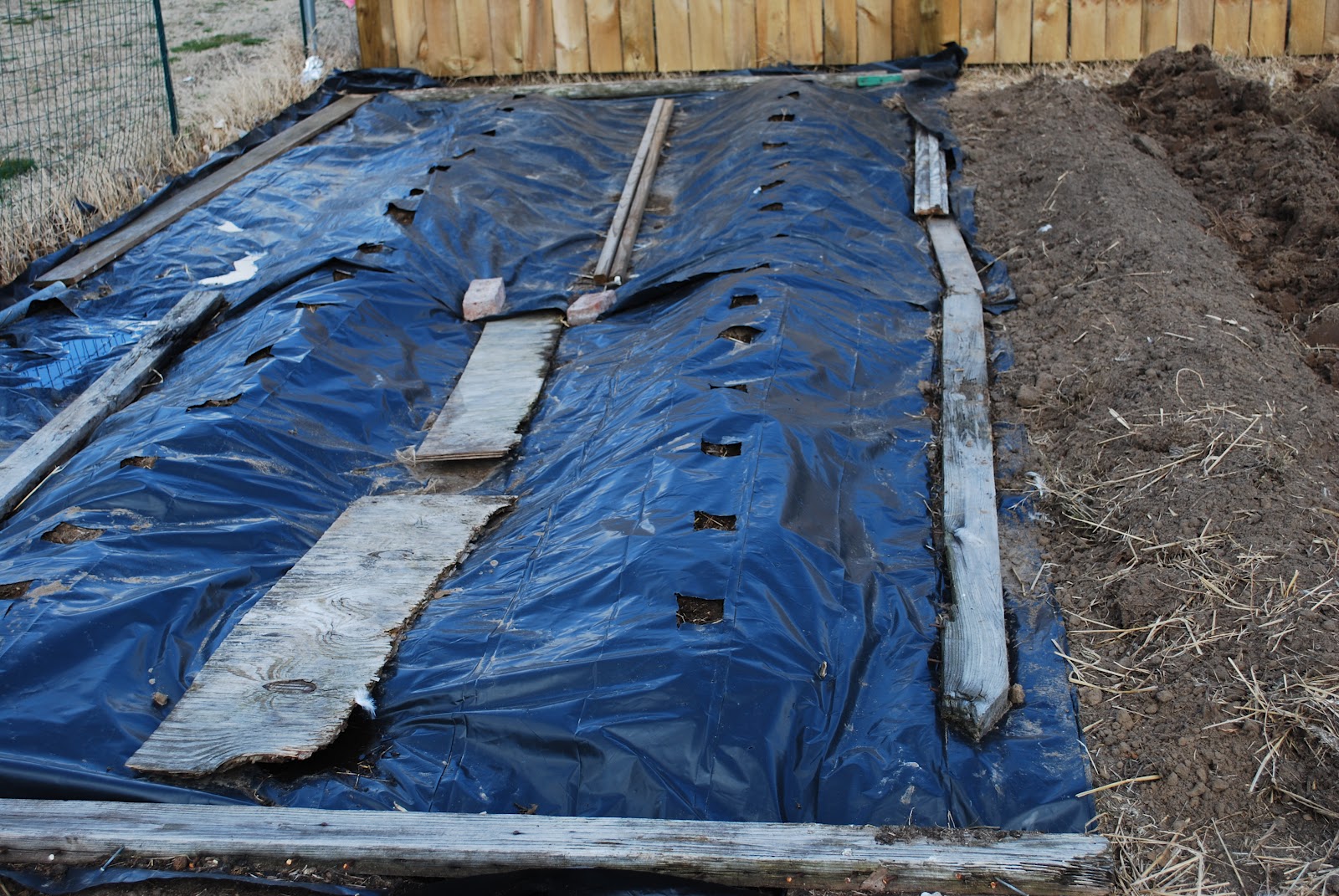
I've laid down scrap lumber to make a walkway. Then I cut holes in the weed barrier and plant in the holes. These two berms have been planted with potatoes. The logs soak up water and hold it in the root zone, containing runoff. Because the logs are buried deep enough to get little oxygen they decompose in a way that does not rob nitrogen from the soil.
Eventually the logs will break down, giving back to the soil all the good nutrients the tree stored up in its lifetime. While my beds aren't to that point yet, I've already seen a big difference in how often I have to water. I water less because the rainfall stays in my beds, held by the soggy logs.
Meet the girls
This Aine. She's still a little shy.

This is Lucy. She's not.

They will both be bred this fall but right now they're working on their championship eating skills.


Tuesday, August 7, 2012
Gardening without rain.
It's not raining here, again. While my own garden is limping along I am surprised it's alive at all. In an ordinary year, the things we do here allow us to conserve water in a big way. I suppose that's what's keeping the crops alive. Water conservation works really well when there is water to conserve.
Here's our favorite low water growing tricks.
1. Hugelkultur. Yes, I've talked about it until you are bored to tears, but it really does work and I'm grateful we built those beds before the drought hit.
2. Plastic mulch. I know. It's plastic. We've tried every plant based mulch and they just don't work for us. We have fine sandy loam soil and an abundance of Bermuda grass. Keeping that devil under control and conserving water at the same time is enough to make us willing to use plastic. Tip - treat it gently, cover it in straw to avoid UV breakdown and you can use plastic mulch for two or three years. Not bad.
3. Use food producing plants with vining habits as ground cover under upright plants. By interplanting tomatoes with cantaloupe the mulch stays shaded and we get twice as many plants in a single bed.
4. Rain barrels. They're awesome. But they only work when there's rain. Ours have been empty for weeks but they sit ready, willing, and able to store water if and when we get some rainfall.
5. Greywater. Greywater from baths and showers is best because it has much less soapy stuff in it. We need greywater that we can harvest temporarily and as low tech as possible. So we hooked up another drain hose to the clothes washer and hung it on an extra barrel by the back door. We collect both the wash and rinse water, letting the rinse water dilute the bad stuff that's in the wash water. It's not a perfect solution. Don't use this kind of greywater more than once a week or you'll build up salts and other nasties in the soil. I only use it on fruit trees and bushes and I make sure to water twice with the hose for every time I use the greywater.
Things we have not done yet that would also help...
- Drip irrigation. Oh yes, I'd love to run some drip line underneath the plastic mulch. So far the budget has not stretched that far but maybe, just maybe.
- Dig a well. I'd looooove to have a well. Using chlorinated municipal water is bad for every plant in the ground. The veggies don't produce well and the forage plants put on new growth at a snail's pace. I put in application for a drought relief well but the conservation guys haven't come out and won't return my calls. Guess all that aid went to the big guys, too.
- Pray harder.
Monday, August 6, 2012
Where have you been, Amy?
I've been right here, slogging along. You see, my county has been in a drought for most of the summer. Now we're at the very worst level on the US Drought Monitor. Bleh.
Dealing with drought is kind of like slowly sinking in quicksand. You go out to the growing beds early to do the watering, hoping to find that the plants have responded to the watering you did late last night. But they haven't. The blossoms open and then they drop. No tomatoes, or beans, or peppers. Days turn into weeks and the plants stop even producing blooms as the limp along.
It simply is not possible to counter extreme heat and drought with a garden hose. Since there was nothing new to report I didn't post any blogs. I was so sure the rain would come and my season could start just a little later than usual.
But the rain hasn't come. And it's time to move forward because this season's harvest is, as my kid says, toast.
So I started an Indiegogo campaign to rebuild the growing beds and improve the general infrastructure so the farm can be more resilient. With proper weed barrier and a drip irrigation system I think we'll recover from our losses. You see, when the plants don't set fruit, there is nothing to sell at the Farmer's Market.
Here's a link to the campaign.
If it sounds like a worthy undertaking to you please share the link freely and widely. Thanks.
I hope to have something to report before long.
Dealing with drought is kind of like slowly sinking in quicksand. You go out to the growing beds early to do the watering, hoping to find that the plants have responded to the watering you did late last night. But they haven't. The blossoms open and then they drop. No tomatoes, or beans, or peppers. Days turn into weeks and the plants stop even producing blooms as the limp along.
It simply is not possible to counter extreme heat and drought with a garden hose. Since there was nothing new to report I didn't post any blogs. I was so sure the rain would come and my season could start just a little later than usual.
But the rain hasn't come. And it's time to move forward because this season's harvest is, as my kid says, toast.
So I started an Indiegogo campaign to rebuild the growing beds and improve the general infrastructure so the farm can be more resilient. With proper weed barrier and a drip irrigation system I think we'll recover from our losses. You see, when the plants don't set fruit, there is nothing to sell at the Farmer's Market.
Here's a link to the campaign.
If it sounds like a worthy undertaking to you please share the link freely and widely. Thanks.
I hope to have something to report before long.
Sunday, June 24, 2012
Managing My Soil OR Talking Dirty
First an announcement from your friendly neighborhood organic farmer...there will be no photos in this post. Why? you ask. Because it's 99 degrees outside and I'm not going back out there.
It's been 6 years since I bought this little house in this little town. For 5 of those years I've been growing most of what we eat and 4 of those years I've been growing for other families, too.
I've had some time to find out what works here and what doesn't. My soil is a fine, sandy loam which means it doesn't hang on to nutrients very well. So I put the chickens to work. Throughout the off season I rotate the chickens through the beds. I let them scratch and dig, eliminating weeds and larvae. When they've completely destroyed any scrap of vegetation, I pile fall leaves about a foot deep in their temporary runs. They shred these leaves, working them into the soil and putting all those lovely micronutrients back. Oh, and they poop. A lot. They put a lot of nitrogen and phosphorus into the soil. I also save big quantities of egg shells. I grind them in a spare coffee grinder and use them and spent coffee grounds as side dressing during the growing season. Finally, I compost until I can't compost any more. I compost chicken, rabbit and goat poo, plus any leaves that may be left, kitchen scraps, garden debris like corn stalks and anything that will sit still long enough. Since I have little to no clay, this organic matter is the only thing holding on to those lovely little cations that make our plants grow.
Because of all this sand, keeping rain where it falls is a big challenge. I have about 3/4 of the garden converted to modified hugelkultur beds. I dig a trench about 18 to 20 inches deep and about the same width. I fill the trenches with logs and branches and use the excavated soil to raise a berm over it. When it rains the logs soak up the moisture and hold it down in the root zone where the plants can get to it. Then I dig another trench parallel to the previous one until my head hits the fence and I'm out of room. Over these berms I lay weed barrier. What! Over the whole thing? Yes, Virginia. Over the whole thing.
We have Bermuda grass. It is of the devil. You could drop a nuclear bomb on my town and, after the smoke clears, you'd find twinkies, cockroaches, and Bermuda grass all sitting there unscathed. So I cover the whole bed in weed cloth and plant my veggies right through it. This also keeps in moisture and reduces erosion.
Your soil will be different. You can get a good idea of what you're working with from the NRCS or USDA websites. Just google "soil survey" and your town or zip code. There is probably a map already online that shows what you have. There is also a Soils Web app for smart phones that gives you results based on GPS coordinates. It's very fun.
Don't be afraid to experiment. It's hard to over-compost. The plants will tell you if you've made a mistake and many times they'll recover and still produce for you.
It's been 6 years since I bought this little house in this little town. For 5 of those years I've been growing most of what we eat and 4 of those years I've been growing for other families, too.
I've had some time to find out what works here and what doesn't. My soil is a fine, sandy loam which means it doesn't hang on to nutrients very well. So I put the chickens to work. Throughout the off season I rotate the chickens through the beds. I let them scratch and dig, eliminating weeds and larvae. When they've completely destroyed any scrap of vegetation, I pile fall leaves about a foot deep in their temporary runs. They shred these leaves, working them into the soil and putting all those lovely micronutrients back. Oh, and they poop. A lot. They put a lot of nitrogen and phosphorus into the soil. I also save big quantities of egg shells. I grind them in a spare coffee grinder and use them and spent coffee grounds as side dressing during the growing season. Finally, I compost until I can't compost any more. I compost chicken, rabbit and goat poo, plus any leaves that may be left, kitchen scraps, garden debris like corn stalks and anything that will sit still long enough. Since I have little to no clay, this organic matter is the only thing holding on to those lovely little cations that make our plants grow.
Because of all this sand, keeping rain where it falls is a big challenge. I have about 3/4 of the garden converted to modified hugelkultur beds. I dig a trench about 18 to 20 inches deep and about the same width. I fill the trenches with logs and branches and use the excavated soil to raise a berm over it. When it rains the logs soak up the moisture and hold it down in the root zone where the plants can get to it. Then I dig another trench parallel to the previous one until my head hits the fence and I'm out of room. Over these berms I lay weed barrier. What! Over the whole thing? Yes, Virginia. Over the whole thing.
We have Bermuda grass. It is of the devil. You could drop a nuclear bomb on my town and, after the smoke clears, you'd find twinkies, cockroaches, and Bermuda grass all sitting there unscathed. So I cover the whole bed in weed cloth and plant my veggies right through it. This also keeps in moisture and reduces erosion.
Your soil will be different. You can get a good idea of what you're working with from the NRCS or USDA websites. Just google "soil survey" and your town or zip code. There is probably a map already online that shows what you have. There is also a Soils Web app for smart phones that gives you results based on GPS coordinates. It's very fun.
Don't be afraid to experiment. It's hard to over-compost. The plants will tell you if you've made a mistake and many times they'll recover and still produce for you.
Monday, June 18, 2012
Celebrate!
Bogger has fixed whatever issue was driving me crazy and I can write again.
I don't have anything deep, philosophical, or earth shattering to say (although I could go off on a rant if you'd like). I discovered something I would like pass along.
Last December I stopped using commercial shampoo. I'm trying to eliminate things I can't pronounce from my life and shampoo is chock full of stuff like that. So I've been using baking soda and vinegar. After the initial adjustment I'm very pleased with the results.
BUT.
I spend most of my day outdoors in the intense Southeast Missouri sun. Yes, I do try to remember to wear a hat but sometimes I forget. My hair paid the price. It became rough and very, very dry. Last night I mixed 1/4 C honey with 2 T olive oil and an egg yolk, got my hair nice and damp and then smeared this concoction all over it, twisting the ends up in a bun so I wouldn't leave a sticky trail all over the house. After 15 minutes I rinsed enough of it out so that I wouldn't draw flies as I slept and went to bed.
This morning I did my usual routine in the shower with baking soda and a vinegar/water rinse. It worked! My hair's all nice and soft again and it moves like it should.
Okay, there's a part of me that feels a little weird about writing a post on hair care. I'm not much into appearances. Most days it takes all my energy to be good, I don't usually have much left to spend on looking good. I suppose this will be my little indulgence. I'll try to write about something really important next time. K?
I don't have anything deep, philosophical, or earth shattering to say (although I could go off on a rant if you'd like). I discovered something I would like pass along.
Last December I stopped using commercial shampoo. I'm trying to eliminate things I can't pronounce from my life and shampoo is chock full of stuff like that. So I've been using baking soda and vinegar. After the initial adjustment I'm very pleased with the results.
BUT.
I spend most of my day outdoors in the intense Southeast Missouri sun. Yes, I do try to remember to wear a hat but sometimes I forget. My hair paid the price. It became rough and very, very dry. Last night I mixed 1/4 C honey with 2 T olive oil and an egg yolk, got my hair nice and damp and then smeared this concoction all over it, twisting the ends up in a bun so I wouldn't leave a sticky trail all over the house. After 15 minutes I rinsed enough of it out so that I wouldn't draw flies as I slept and went to bed.
This morning I did my usual routine in the shower with baking soda and a vinegar/water rinse. It worked! My hair's all nice and soft again and it moves like it should.
Okay, there's a part of me that feels a little weird about writing a post on hair care. I'm not much into appearances. Most days it takes all my energy to be good, I don't usually have much left to spend on looking good. I suppose this will be my little indulgence. I'll try to write about something really important next time. K?
Subscribe to:
Posts (Atom)